
This page is about heatsinks cut from solid metal: what sets the price, where machining stops being the sensible process, and what to send if you want a quote that survives the first article. It starts with the case against machining, because a large share of the heatsink drawings that reach us would cost less as an extrusion with a few machined features added afterwards.
If the process decision is already made and you want a number, email the drawing. Everything below is for the case where it is still open, or where a machined heatsink came back at three times the price you expected and you want to know which line item did it.
First question: does it need to be machined?
A heatsink is mostly air. Machining one from solid means buying a block, removing most of it, and paying for the time that removal takes. That is a reasonable trade in some situations and a poor one in others, and the difference is usually visible from the drawing before anyone quotes it.
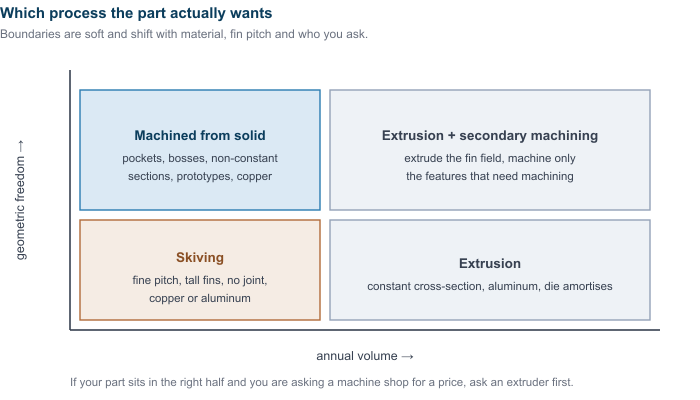
Machining earns its cost when:
- The cross-section is not constant — stepped bases, pockets for components, fins that stop partway, mounting bosses integrated into the body
- Quantities are low enough that tooling cost would dominate
- The material is copper, or an alloy that is not an extrusion alloy
- The part has to interface with something on several faces and the tolerances between those faces matter
Machining is the expensive answer when:
- The profile is genuinely constant along one axis and the volume is high enough for a die to amortise
- The fin field is the whole part and there are no other features
- The fin pitch is fine enough that skiving would produce more surface area for less money
Here is the version that costs us work: if your part sits in the right half of that map, get an extrusion quote before you get a machining quote. We would rather lose the fin field to an extruder and machine the features that actually need machining than quote the whole thing and watch the price kill the programme. A hybrid route — extruded profile, machined pockets and mounting faces — is often the cheapest thing on the table and almost nobody asks for it.
The gap between the fins sets the price
The single number that drives a machined heatsink quote is not the fin count and not the overall size. It is the ratio of fin height to gap width.
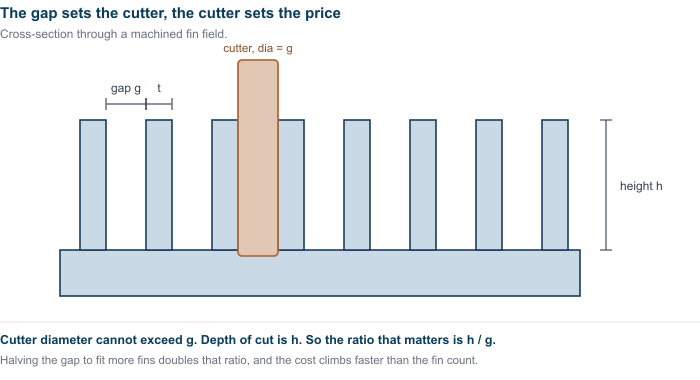
A slot cutter cannot be wider than the slot it cuts. So the gap fixes the cutter diameter, the fin height fixes the depth of cut, and the shop is left holding a depth-to-diameter ratio it did not choose. The bands look like this — the same bands that govern the depth-to-width limits on a machined flow channel, for the same reason:
| Height ÷ gap | What happens |
|---|---|
| Up to 3:1 | Routine. Nobody comments. |
| 3:1 to 5:1 | Lighter passes, slower feed, a spring pass. Cycle time climbs and the quote reflects it. |
| 5:1 to 8:1 | Reduced-neck or extended-reach tooling. More fragile, more expensive, more likely to break inside a nearly finished part. |
| Above 8:1 | Milling is the wrong process. Look at skiving, bonded fin, or extrusion. |
The trap is that fin density and this ratio move together. Narrowing the gap to fit more fins into the same footprint raises the ratio on both counts at once: the cutter gets smaller and the reach stays the same. Doubling the fin count does not double the price. It does something worse than that.
Design lever: if you need more surface area, look at making the fins taller before you look at making them thinner. Height costs linearly. Gap costs steeply.
Fin thickness has its own floor
The other limit is the fin itself. A tall thin fin standing free while a cutter passes down one side is a cantilever, and it behaves like one.
In aluminum the failure is elastic: the fin bows away from the cutter, comes back after the pass, and measures thinner at the tip than at the root. In copper it is different, and the usual assumption gets it backwards. Copper is the stiffer material — its elastic modulus is roughly 117 GPa against about 69 GPa for 6061 — but it yields at a far lower stress. The fin holds shape under load and then takes a permanent set, smears at the tip, or rolls a burr instead of shedding one. The mechanism is set out in more detail alongside the other things that change when a part is copper rather than aluminum.
Either way the practical consequence is the same: below a certain thickness the fins stop being a machining problem and become a different-process problem. If your drawing calls for fins under about half a millimetre standing more than a few millimetres tall, skiving is worth a serious look. Skiving peels the fins up out of the solid base rather than cutting the gaps away, so there is no cutter to fit in the gap, no joint between fin and base, and no thermal interface where the two meet.
Where the money goes on a machined heatsink
| Cost line | Comment |
|---|---|
| Raw block | You buy the solid, not the part. On copper this line can dominate everything else. |
| Roughing the fin field | Scales with the depth-to-gap ratio, not with part size. |
| Finishing the base | Flatness and finish on the contact face; often a separate operation. |
| Deburring | Manual, proportional to fin count, does not scale away at volume. |
| Anodizing or plating | Masking is the cost, not the coating. |
| Chip value | Meaningful on copper. Ask whether it is credited back. |
Two things follow. First, on a copper heatsink the material line can be larger than the machining line, which means the part gets less cheap at volume than buyers expect — setup amortises, metal does not. The shape of that curve, with a worked example, is in the page on how prototype and production pricing actually diverge.
Second, if you are buying a solid copper block and paying to turn most of it into chips, that is the moment to ask whether skiving or a bonded-fin construction gets you the same surface area out of less metal. Sometimes it does not. It is always worth asking.
The base is where the heat actually enters
Fin geometry gets the attention; the mounting face decides how much of that geometry does any work. Three things to specify rather than leave to the routing sheet:
- Flatness, over the area that matters. Flatness across a 200 mm base is a different part, at a different price, from flatness across the 40 mm square where the device actually sits. Say which. And say at what stage it is measured — before or after any subsequent operation, free-state or clamped.
- Surface finish and tool mark direction. A face-milled base carries a directional pattern. For a thin thermal interface material that direction can matter; for a thick pad it does not. If it matters, say so.
- Whether the contact face is coated. A coating in the exact place you are trying to remove heat is a decision, not a default.
On anodizing there is a claim worth pushing back on. Black anodize raises emissivity, and emissivity matters when the heatsink is shedding heat by radiation and natural convection. In a rack with air moving over the fins, radiation is a small share of the total and the finish is doing very little thermally. It is still worth specifying for corrosion resistance, handling and appearance. It is mostly not worth specifying as a cooling measure, and a supplier who sells it to you as one is telling you something about the rest of their advice.
What to send, and what to ask whoever quotes it
To get a quote that holds:
- STEP or Parasolid, plus a PDF drawing if you have one
- Material and temper, or a note that you want a recommendation
- Flatness and finish on the contact face, with the area and the stage stated
- Which tolerances actually matter, marked as such — a drawing where everything is tight prices as though everything is tight
- Prototype quantity and realistic annual volume, stated separately
- Whether the process is fixed, or whether extrusion and skiving are open for consideration
That last line is the one buyers leave out most often, and it is the one that unlocks the largest savings. A shop that only machines will quote machining. If you tell it the process is open, you find out whether it is willing to route work away from itself — which is one of the more reliable ways to tell a manufacturer from a broker.
Two questions worth putting to any supplier, including us: what fin height-to-gap ratio do you treat as routine, and where do you start adding cost? A specific answer means they have thought about it. A number with no explanation, or an answer that avoids the question, means the ratio will show up later as a surprise. And: what would you change about this drawing? Silence is not agreement.
When we are the wrong shop
- You need parts inside a week. International logistics make us the wrong choice at that schedule. Use a domestic quick-turn shop.
- The design is changing weekly. Buy locally and pay the premium for the feedback loop until the geometry settles.
- You need high-volume extruded profiles. Go to an extruder. We can machine the features afterwards if that helps, but the fin field is not ours to quote.
- You need a complete thermal assembly. Heat pipes, vapour chambers, fan assemblies, complete cooling systems — outside what we build. We machine plates and thermal parts.
Send a drawing
Every drawing gets a manufacturability review before it gets a price. Anything in the geometry that costs money without buying thermal performance comes back in writing before the number. If the honest answer is that this part wants to be an extrusion, that is what the reply will say.
Files go to sales@thermalkerf.com, which handles attachments and is the faster route. For anything else, the form below reaches the same inbox, and the full contact details are on the contact page. If the part is a liquid-cooled plate rather than an air-cooled heatsink, start with CNC machined cold plates instead.