
If you are sourcing cold plates, you have probably opened eight or ten supplier websites this week and found that they all say the same things. Vacuum brazing, friction stir welding, CNC machining. ISO 9001. Fast turnaround. Free CFD. Custom solutions for your application. The pages are interchangeable, and none of them helps you decide.
Part of the reason is that most supplier selection guides are written by suppliers, and the criteria are reverse-engineered from what the author happens to be good at. A shop with a CFD licence writes that you must check for simulation capability. A shop with IATF 16949 writes that automotive certification is the mark of a serious partner. A shop with a low prototype minimum writes that MOQ is the thing to watch. Read ten of these and you get ten incompatible checklists.
We are one of those suppliers, so treat this page accordingly. What follows is written to be useful even if you buy from someone else, which means the criteria are things you can verify yourself during a normal RFQ — before any money changes hands — rather than claims you have to take on trust. There is also a section on where we would fail our own test.
The cheapest qualification tool you have is the RFQ itself
Site audits are expensive and slow. Sample orders cost money and six weeks. But sending a drawing to five shops costs you nothing, and the replies tell you most of what a first-round audit would.
Most buyers read those replies for price and lead time and discard everything else. The discarded part is the useful part. Below are the things worth reading for, roughly in order of how much they predict.
1. Put a deliberate manufacturability trap in the drawing
This is the single most informative thing you can do, and almost nobody does it.
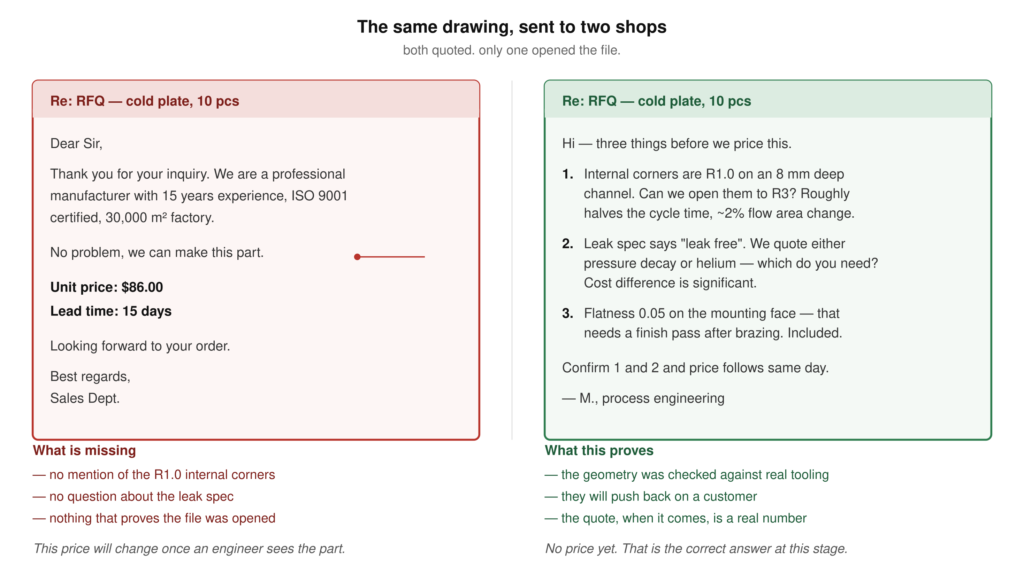
Specify something in the flow channel that is drawable but not sensibly machinable. The classic is an internal corner radius smaller than any reasonable cutter — R1.0 on the inside corners of a channel that is 8 mm deep, for instance. A cutter that could produce it would be far too slender for the depth, so the shop must either use a much smaller tool with many shallow passes, EDM the corners, or come back and ask whether R3 would do.
We ran this as an experiment, sending the same drawing out the way a buyer would. Six shops quoted it. Not one of them mentioned the corner radius. All six returned a price and a lead time.
That result is worth sitting with, because there are only two explanations and both matter to you. Either nobody looked at the geometry before quoting — in which case the number you received is not a real price and will be revised once the job reaches an engineer — or somebody looked, saw the problem, and quoted anyway, planning to raise it after the PO. Neither is a supplier you want finding out about your part at the same time you do.
A good reply does not have to be sophisticated. “Can we open the internal corners to R3? It will cut the machining time significantly and we don’t think it affects your flow area much” is exactly right. It proves the drawing was opened, understood, and checked against real tooling. It also tells you the shop is willing to push back on a customer, which is the trait you will want most when something is genuinely wrong later.
Other traps that work the same way: a flatness callout on the mounting face that is tighter than the joining process can hold without a post-braze finish pass; a channel wall left too thin to run a friction stir weld land along; a coolant port on a face the fixture will have to clamp.
2. Count who replies at all, and how fast
A separate exercise: we sent an enquiry to five shops through a domestic Chinese sourcing platform. One replied.
The four who did not were not necessarily bad manufacturers. Some of them are probably very good at making parts. But an enquiry from an unfamiliar name, in a foreign language, for a quantity of ten, sits at the bottom of a queue behind existing customers ordering thousands. That is a rational commercial decision on their part. It is also a preview of what happens to your engineering change request in month four.
So the useful signal is not really speed. It is where you sit in the queue, and response behaviour is the only visible proxy for it before you place an order. A shop that replies to a small enquiry in a day is telling you something about how it will handle a small problem in a year.
The corollary, which cuts against our own interest to point out: if your programme is heading for tens of thousands of units, the shop that is desperate to answer your ten-piece enquiry may not be the one that can absorb your production ramp. Response speed and scale capacity are frequently inversely correlated. Decide which you are buying.
3. Ask who is writing to you
Read the reply for whether it came from someone who can make a technical commitment or someone relaying messages. It is usually obvious within two exchanges. Ask a follow-up question that requires a judgement rather than a lookup — “would you machine this from plate or from extrusion, and why?” — and see whether the answer arrives in an hour with reasoning, or in two days with a paragraph that does not quite address it.
This matters more than it sounds for a part like a cold plate, where most of the cost is set by geometry decisions made in the first week.
4. Ask them to tell you what they will not do
“What kind of work do you turn down?” is a hard question to answer glibly, and the answer is diagnostic.
A shop with a real position will name things: sizes past the furnace envelope, tolerances they cannot hold, industries whose paperwork they are not set up for, quantities below or above their economic band. A shop that says it can do everything either has no idea what its constraints are, or intends to subcontract the parts it cannot make — which is fine if disclosed and a problem if not.
The related question is more specific and worth asking directly: which of your listed processes do you run in-house, and which do you buy? Vacuum brazing furnaces and FSW machines are expensive. Plenty of legitimate suppliers subcontract one of them. The issue is not subcontracting; it is a supplier who lets you assume otherwise, because it changes who controls your schedule and who can be in the room when something goes wrong.
5. Separate “we have done it” from “we do it in production”
These are very different claims and the language routinely blurs them.
A shop we work with put it plainly when asked about copper: they had made many copper plates, but few of them in series production. That is an honest and useful answer. It means the process exists and the samples were fine, and it also means the yield data, the fixture refinement, and the operator experience that only come from repetition are not there yet. For a prototype that is irrelevant. For a production award it is the whole question.
Ask it as a number rather than as a yes/no: how many of these did you ship last year? If the answer is a portfolio photograph rather than a quantity, you have learned something.
6. Ask how they will leak test it, before you ask the price
A cold plate is a pressure vessel with your hardware bolted to it. The leak test is the acceptance criterion that matters, and it is where quoted prices most often turn out not to be comparable.
Ask for three things: a method, a test pressure, and a leak rate. Water immersion, pressure decay, and helium mass spectrometry are separated by orders of magnitude in sensitivity and by a large factor in cost. A supplier quoting immersion testing against a supplier quoting helium is not a price comparison at all, and the gap will usually explain most of the difference between two numbers you were about to treat as the same part.
Then ask what happens to a plate that fails, and whether every unit is tested or a sample. If the answer is a sampling plan, that is a legitimate choice — but you should be the one making it.
Put your requirement on the drawing rather than in the email. “Leak free” is not a specification and cannot be enforced.What to write instead — method, rate, pressure, dwell, sampling — is set out separately.
The awkward part: verifying a supplier you cannot visit
Here is where we would fail a conventional checklist, so it is worth explaining rather than skipping.
Standard advice says to require the factory name, the address, and scans of the certificates up front. Many China-based suppliers, including us, will not publish those on a public page. The reason is not mysterious: a buyer who has the factory name and address can go around the supplier and contract the plant directly. It happens often enough that the practice of withholding is now normal, and it is not by itself evidence of anything.
It does leave you with a real problem, so here is what to substitute:
- Ask for a live video walk of the specific equipment. Not an edited facility film — a call, at a time you choose, where someone walks to the furnace or the FSW machine and you ask them to point the camera at things. This is difficult to fake and costs you twenty minutes. Any supplier who refuses it outright has told you something.
- Ask for certification records once the project is real. Most suppliers who will not post certificates publicly will share them under a signed enquiry or an NDA. If the answer is still no at that stage, that is a different matter.
- Ask process questions only someone with the equipment can answer. What is the hot zone size of the furnace. What filler alloy and what cycle for a 6061 part, and whether they would push back on 6061 at all. What tool material for copper. Vague answers to specific process questions are more revealing than any document.
- For a first order, use payment terms rather than paperwork. A deposit against a first article, with the balance on acceptance, transfers more real protection than a certificate scan does.
And be clear with yourself about what ISO 9001 actually certifies. It certifies that a quality management system exists and is followed — that procedures are documented and records are kept. It does not certify that the parts are good, and it says nothing about whether the shop has ever made a cold plate. It is a floor, not a differentiator, and every serious supplier has it. Treating it as a selection criterion mostly filters out very small shops, some of which are excellent.
Things that look like signals and are not
- A long client logo wall. Usually unverifiable, frequently means one order from a subsidiary five years ago. If a logo matters to you, ask which part, which year, and whether you can be referred.
- Floor area and machine count. Impressive and largely irrelevant to whether your ten-piece order gets attention. A large plant may be worse for you, not better, depending on where you sit in its order book.
- A free CFD offer. Genuinely valuable when it is an engineer running your geometry and telling you something you did not know. Much less so when it is a marketing deliverable — a coloured contour plot that confirms the design you already sent. Ask what they would change as a result of the simulation. If nothing, the simulation was decoration.
- Published thermal resistance figures. Meaningless without the flow rate, the coolant, the heat source footprint, and the interface material they assume. Two plates quoted at different assumptions are not comparable, and the assumptions are usually not stated.
- Very low prototype MOQ. Useful, but check what it costs per unit and whether the price structure at production quantity is disclosed. A cheap prototype from a shop whose production pricing turns out to be uncompetitive has cost you a qualification cycle, which is worth far more than the prototype.
The genuine trade-off nobody states plainly
Most of the real decision comes down to one axis, and it is not quality.
A domestic shop in your own country gives you short shipping, same time zone, a site you can drive to, and simpler recourse if things go wrong. You pay a premium for it, and the premium is real. An overseas supplier gives you a lower part price and, usually, more willingness to take small and awkward work — against longer transit, a working day that overlaps yours by an hour or two, and remote-only recourse.
Which is correct depends almost entirely on where your programme is. If you are three iterations from a design freeze and each iteration teaches you something, transit time is your dominant cost and a local shop is probably right even at a premium. If your geometry is stable and you are buying against a schedule, the calculation reverses.
We would rather say that than pretend the answer is always us. If you are still iterating weekly, buy locally for now and come back when the drawing settles.
A short version you can run this week
- Take your drawing and leave one deliberate manufacturability problem in it.
- Send it to five shops with a leak requirement stated as method, pressure and rate.
- Note who replies, how fast, and whether the reply came from someone technical.
- Discard anyone who quotes the trap without mentioning it.
- Of those left, ask each what they would change about the design, which processes are in-house, and how many of this type they shipped last year.
- Ask the remaining two for a live video walk of the equipment that will make your part.
That sequence costs you a few hours and no money, and it removes more risk than a certificate review.
Send a drawing
You are welcome to run the above on us. Send a drawing — traps included, we would rather find them — and you will get a manufacturability check with the quote, within one working day, from someone who has looked at the geometry. If we think the part should be made a different way, or bought closer to home, we will say so.
Certification records are available on request once a project is under discussion, and a video walk of the equipment can be arranged at a time that suits you.
What we build, what we do not build, and what to include in an RFQ is set out on the cold plate machining page.
If you are earlier than the RFQ stage, two related pages may be more use: Cold Plate Channel Design: Manufacturability Constraints covers the geometry decisions that set most of your cost, and Vacuum Brazing vs. Friction Stir Welding for Cold Plates covers how the cover joint gets chosen — including when you should not buy a sealed plate at all.