
ThermalKerf provides aluminum cold plate machining for custom 6061 and 6063 parts built to customer drawings. We machine flow channels, ports, mounting features, and thermal-interface surfaces, then evaluate aluminum friction stir welding or vacuum brazing according to the construction.
We support single prototypes through repeat production in the low hundreds. Every RFQ receives a manufacturability review before pricing; send a STEP model and dimensioned PDF drawing and we respond within one working day.
Aluminum Cold Plate Capabilities at a Glance
| Materials | Aluminum 6061 / 6063 |
| Quantity | Single prototypes through repeat batches in the low hundreds |
| CNC work | Machined channels, pockets, ports, mounting features, and thermal-interface surfaces |
| Joining | Aluminum friction stir welding or vacuum brazing, selected during DFM review |
| Post-joining work | Finish machining of critical surfaces, datums, threads, and other drawing-defined features where required |
| Inspection | Drawing-defined dimensional inspection and documentation |
| Leak testing | According to the customer drawing or test specification |
| RFQ input | STEP model + dimensioned PDF drawing preferred |
| DFM | Manufacturability review before pricing |
| Response | Within one working day |
| Confidentiality | NDA available; customer drawings treated as confidential |
| Supplier verification | Live video walk of relevant manufacturing equipment can be arranged |
6061 and 6063 for Aluminum Cold Plate Manufacturing
6061 and 6063 are both practical starting materials for machined aluminum cold plates, but we do not treat them as interchangeable grades.
The correct choice depends on the released drawing, material temper, mechanical requirements, joining route, thermal requirements, and any downstream finishing specified by the customer.
6061 is widely used for machined cold plates where the design needs a useful combination of machinability and mechanical strength. It also appears frequently in aluminum friction stir welded cold plate constructions.
6063 is also used in thermal-management components and can be appropriate where the drawing, material condition, joining method, and thermal requirement support it. If the customer drawing specifies 6063, we quote the project against that grade rather than automatically substituting 6061.
The alloy designation alone is not enough to select the manufacturing process. In particular, a vacuum-brazed assembly must be reviewed against the complete material and joining specification because the whole part passes through a furnace cycle.
CNC Machining Aluminum Cold Plate Channels
Most custom aluminum cold plates begin with CNC machining of the base plate. The channel network, sealing land, ports, mounting holes, pockets, and critical interfaces all need to work as one manufacturable design.
Outside dimensions alone are a poor predictor of machining difficulty. Channel depth, width, internal corner radius, remaining wall thickness, number of setups, and tool access usually matter more.
- Deep or narrow channels can require longer tools, slower cutting conditions, and additional passes.
- Small internal radii may force the use of smaller cutters and significantly increase cycle time.
- Thin walls between channels can affect both machining stability and the joining route used later.
- Ports on multiple faces can add setups and may be better machined before or after joining depending on the design.
- Critical thermal-interface surfaces may require a separate finish-machining operation after the plate has been joined.
If the channel layout is still flexible, see our cold plate channel design guide for cutter-limited corner radii, depth-to-width ratio, wall thickness, and sealing-land considerations.
FSW vs Vacuum Brazing for Aluminum Cold Plates
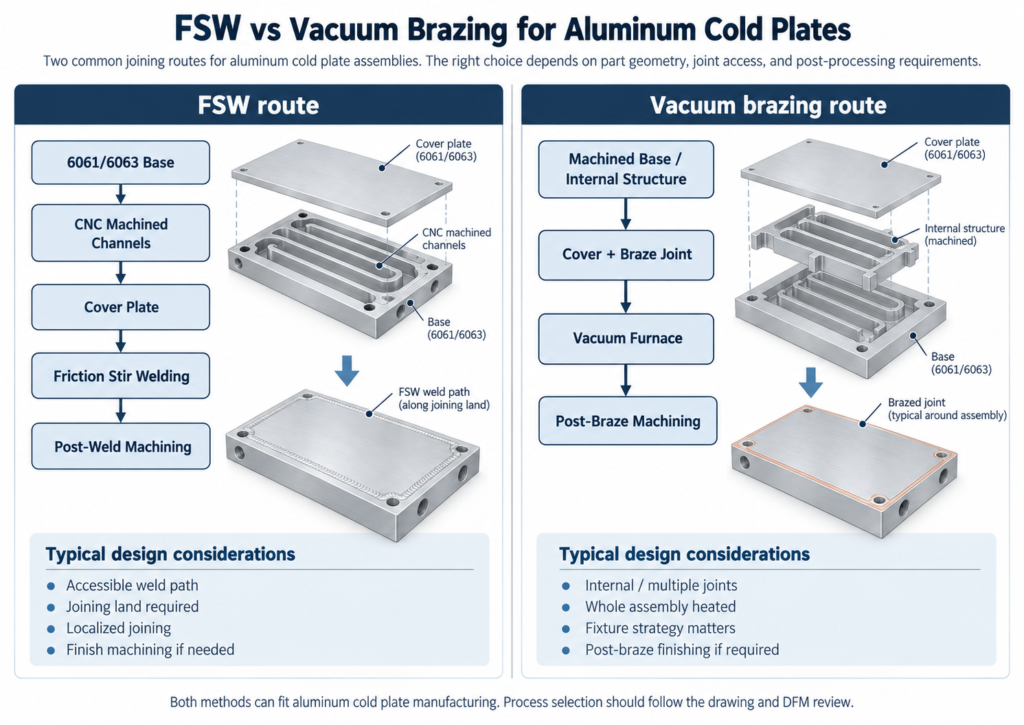
Aluminum cold plates can be sealed by friction stir welding or vacuum brazing, but the two processes impose different design constraints. We select the route against the actual drawing rather than treating one process as universally better.
When Friction Stir Welding Fits the Design
Friction stir welding is a strong candidate when a machined aluminum base and cover can be joined along an accessible weld path with sufficient material around the channel network for the tool and fixture loads.
Because FSW is a localized solid-state joining process, the complete plate does not need to pass through the same whole-part furnace cycle used for vacuum brazing. The weld path, however, must be physically reachable by the tool and designed with a suitable joining land.
The joining operation can also leave a visible tool path or local surface condition on the welded face. Where that surface is critical, finish machining can be included after FSW.
When Vacuum Brazing Fits the Design
Vacuum brazing can be a better manufacturing route when the assembly contains internal joints, fin structures, or geometries that cannot be reached by a friction stir welding tool.
The trade-off is that the complete assembly passes through a controlled furnace cycle. Material condition, joint design, fixture strategy, distortion, and any required post-braze machining therefore need to be reviewed together.
If your design is not committed to a joining process yet, our vacuum brazing vs friction stir welding guide explains the manufacturing trade-offs in more detail.
Post-Joining Machining and Flatness
A cold plate does not necessarily leave the FSW or brazing operation in its final dimensional condition.
Where the drawing defines a critical mounting face, thermal-interface surface, datum, or port feature, the manufacturing route may place the finish-machining operation after joining rather than before it.
This is particularly important for flatness. A useful flatness requirement needs a defined surface, datum structure, measurement span, and final manufacturing condition. We therefore do not publish one universal flatness number for every aluminum cold plate.
The correct answer depends on the plate size and thickness, channel layout, joining process, fixture strategy, and whether a final machining pass is allowed after joining.
Prototype and Low-Volume Aluminum Cold Plates
CNC machining is well suited to aluminum cold plate programs that begin with a small number of engineering parts and may later move into repeat production.
The unit price normally changes as quantity increases because programming, fixtures, setup, first-article work, and joining preparation are spread across more parts. A five-piece prototype price should therefore not be multiplied directly to estimate the cost of a repeat batch.
When future volume is known, include both the quantity required now and the expected production quantity in the RFQ. This allows the prototype route to be quoted realistically without ignoring the economics of later repeat production.
For a more detailed explanation of this cost curve, see low-volume cold plate manufacturing.
DFM Issues We Check Before Quoting
Most aluminum cold plate RFQs do not fail because the outside dimensions are impossible. The difficult details are usually inside the channel network or around the joining and finishing requirements.
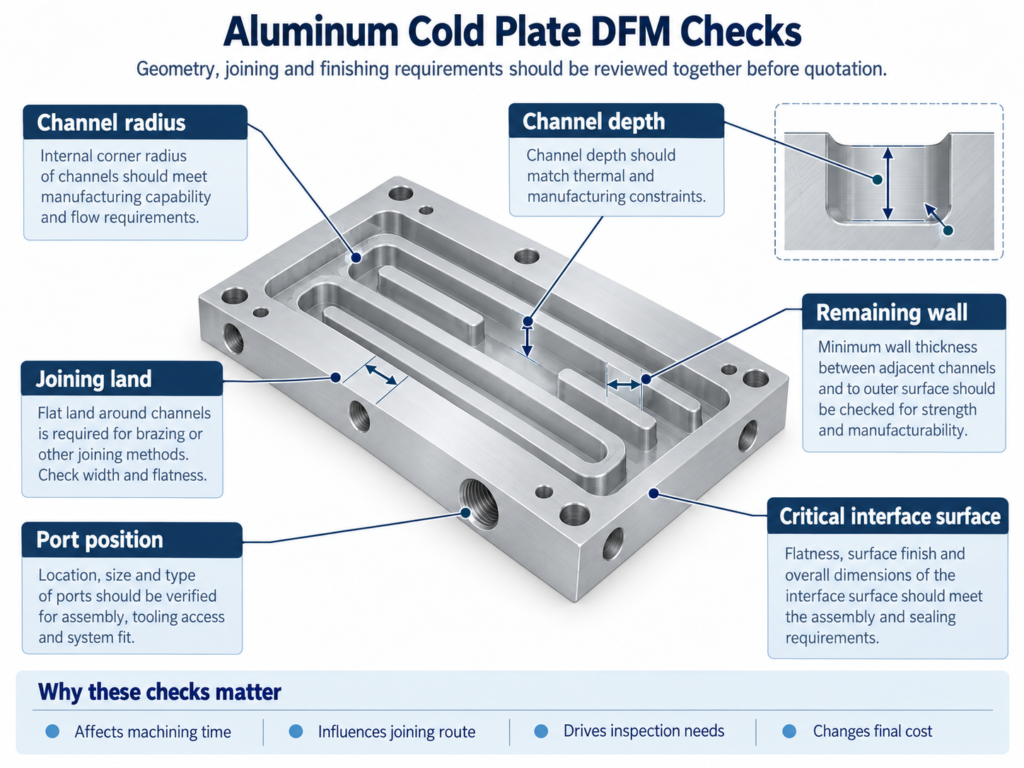
- Internal corner radius. Does the drawing force an unnecessarily small cutter?
- Channel depth and remaining wall. Is there enough material to machine the channel without creating an unstable wall or base?
- Joining land. Does the design leave sufficient material around the channel network for the selected FSW or brazing route?
- Cover construction. Is the cover thickness and joint geometry compatible with the selected sealing process?
- Port position and machining sequence. Should the threads or sealing surfaces be machined before or after joining?
- Critical flatness and surface finish. Does the drawing require post-joining finish machining?
- Leak-test requirement. Is the test method and acceptance criterion actually defined rather than described only as “leak free”?
Where a change can materially reduce machining or joining cost without changing the functional requirement, we identify it during DFM review before the project reaches a purchase order.
What to Send for an Aluminum Cold Plate Quote
A STEP model and dimensioned PDF drawing are the best starting point. Include the aluminum grade and temper if defined, prototype quantity, expected production quantity, critical surfaces, joining requirement if already selected, and the inspection or leak-test specification that applies to the finished plate.
For the complete RFQ checklist and an explanation of the main pricing factors, see our cold plate machining quote guide.
If you are still comparing material and overall manufacturing routes rather than only aluminum, start with our CNC machined cold plate supplier page.
Aluminum Cold Plate Machining FAQ
Do you machine both 6061 and 6063 aluminum cold plates?
Yes. We quote custom aluminum cold plates in 6061 and 6063 against the customer drawing. We do not automatically substitute one grade for the other because material condition, joining route, and mechanical requirements can affect the manufacturing plan.
Can a 6061 aluminum cold plate be friction stir welded?
Yes. Aluminum friction stir welding is one of the joining routes we evaluate for machined 6061 cold plates when the cover design, weld path, joining land, and fixture access are suitable.
Do you vacuum braze aluminum cold plates?
Yes. Vacuum brazing is available for aluminum cold plate assemblies. The material condition, joint design, internal geometry, furnace cycle, and any required post-braze machining are reviewed together before quotation.
Is FSW always better than vacuum brazing for aluminum cold plates?
No. FSW works well when the closure joint is accessible to the tool and the design provides a suitable weld land. Vacuum brazing can be more appropriate for internal fin structures, multiple internal joints, or assemblies where the required joints cannot be reached by an FSW tool.
Can you guarantee a standard flatness value?
We do not publish one flatness number for every aluminum cold plate. The achievable result depends on the plate geometry, datum, measurement span, joining route, material condition, and whether finish machining is allowed after joining.
What quantities do you support?
We support single prototypes through repeat batches in the low hundreds. When possible, send both the prototype quantity and expected production quantity so that setup and batch costs can be evaluated correctly.
How quickly will you respond to an aluminum cold plate RFQ?
We respond within one working day. A complex drawing may require technical clarification before a final firm price can be completed.
Send an Aluminum Cold Plate Drawing
Send your STEP model and dimensioned PDF drawing to sales@thermalkerf.com, or use the form below.
Customer drawings are treated as confidential. NDA is available on request, and a live video walk of relevant manufacturing equipment can be arranged once a project is under discussion.
Every RFQ receives a manufacturability review before pricing. We respond within one working day.