
Send us your STEP model, 2D drawing, and required quantity. We review the manufacturing route before pricing the part, including machining, joining, post-machining, inspection, and leak-test requirements.
ThermalKerf machines custom cold plates in aluminum 6061 and 6063, and copper C11000 and C10200. We support single pieces and prototypes through repeat production in the low hundreds.
For aluminum cold plates, we can evaluate friction stir welding or vacuum brazing. For copper cold plates, vacuum brazing is the standard joining route we quote unless another construction has been reviewed first.
Every RFQ receives a manufacturability review. We respond within one working day. Complex drawings may require technical clarification before a firm price can be completed.
For the fastest review, send your STEP and PDF files to sales@thermalkerf.com. NDA is available on request.
What to Send for a Cold Plate Machining Quote
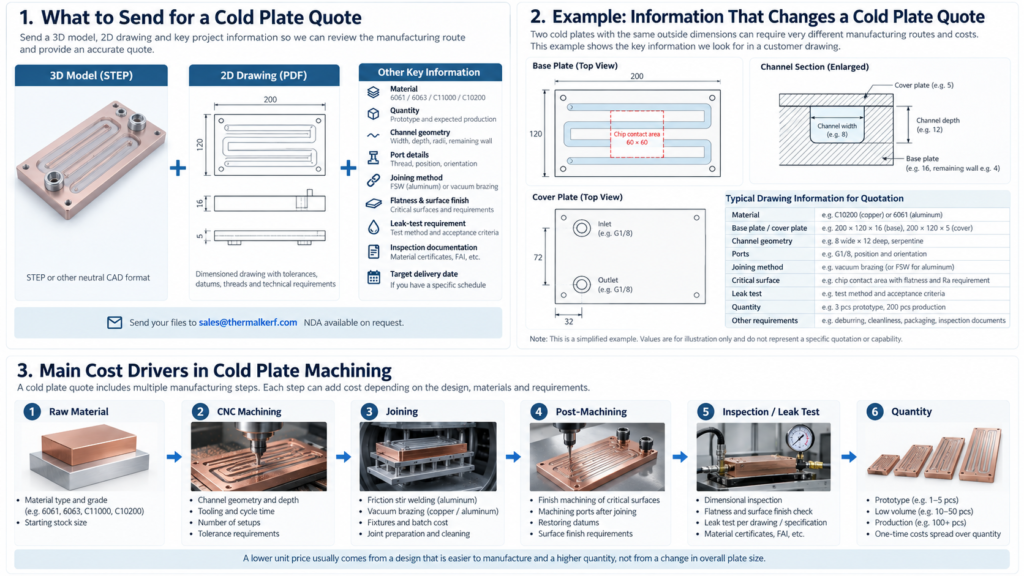
A 3D model tells us what shape to machine. It usually does not contain enough information to price the complete cold plate.
For a reliable quotation, send the STEP model together with a controlled 2D drawing wherever tolerances, joining, testing, or inspection requirements matter.
The most useful RFQ information includes:
- 3D model — STEP or equivalent neutral CAD format.
- 2D drawing — critical dimensions, tolerances, datums, threads, surface finish, and inspection requirements.
- Material — for example 6061, 6063, C11000, or C10200.
- Quantity required now — especially for prototypes and first articles.
- Expected production quantity — if the project may move into repeat production.
- Channel geometry — width, depth, internal radii, remaining wall thickness, and any critical channel features.
- Port details — thread specification, position, orientation, and whether ports must be machined before or after joining.
- Joining requirement — friction stir welding, vacuum brazing, or a construction that still needs process selection.
- Critical flatness and surface finish — especially on thermal interface surfaces.
- Leak-test requirement — test method and acceptance criteria according to your drawing or specification.
- Inspection documentation — material certificates, FAI, dimensional reports, or other required records.
- Delivery requirement — prototype lead time depends on the manufacturing route and current production schedule.
If the design is still being developed, thermal information such as heat load, coolant, and flow rate can also help during DFM review. For a broader overview of the parts, materials and manufacturing routes we support, see our CNC machined cold plate capabilities. For a released made-to-drawing part, however, the manufacturing drawing remains the primary quotation document.
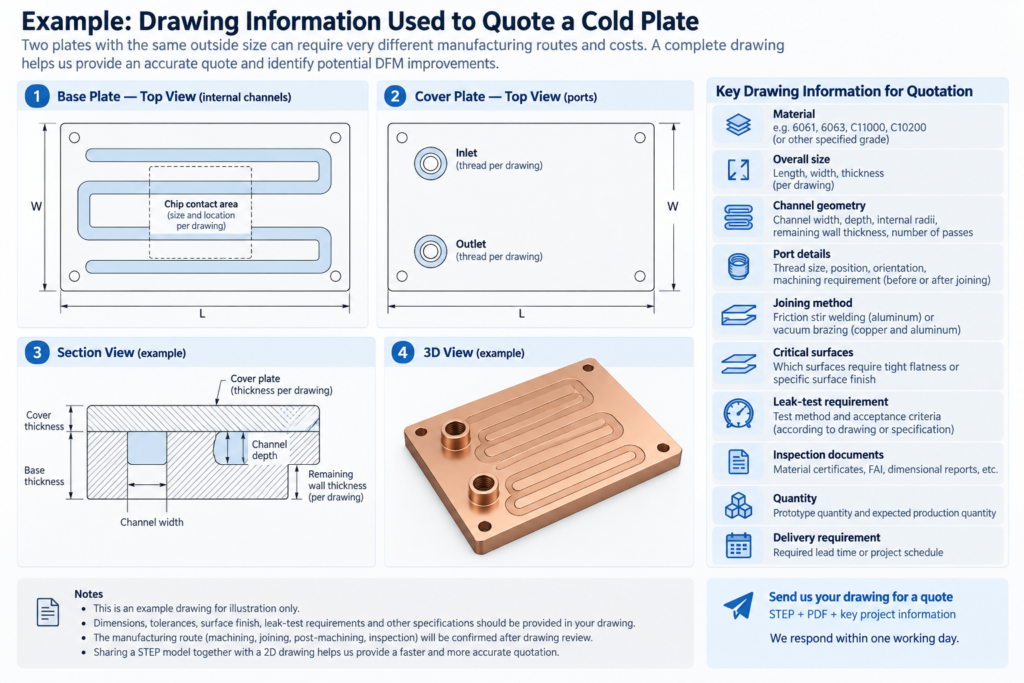
Why Plate Size Alone Is Not Enough for Pricing
Two cold plates with the same outside dimensions can require very different manufacturing routes and therefore very different prices.
Outside dimensions mainly tell us how much material is involved. They do not tell us how much machining, joining, inspection, or post-processing is required.
A simple shallow channel can be relatively straightforward to machine. A deep or narrow channel may require longer tools, slower cutting conditions, additional passes, or different fixturing.
Internal corner radii also matter. A smaller radius may require a smaller cutter, increasing machining time. Thin walls between channels can change the toolpath and workholding strategy.
Joining changes the cost structure again.
A machined base and cover that are vacuum brazed require more than the initial CNC operations. The quotation may also need to include joint preparation, fixtures, the brazing cycle, cleaning, and any finish machining required after joining.
The same principle applies to friction stir welded aluminum plates. The weld path, cover design, available sealing land, and post-weld machining requirements all affect the manufacturing route.
Inspection also needs to be defined.
“Leak free” is not enough information to price a test. The drawing or specification should state the required test method and acceptance criteria.
That is why we prefer to review the actual STEP model and drawing rather than estimate a finished cold plate from length × width × thickness.
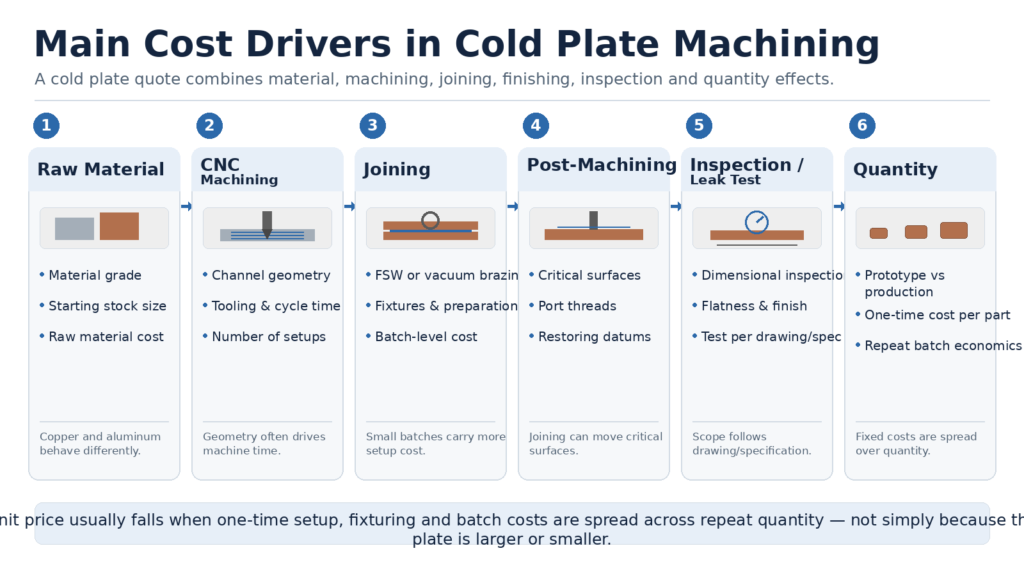
What Drives Cold Plate Machining Cost
A cold plate quotation normally contains both fixed project costs and costs that repeat on every part.
Understanding that distinction is more useful than comparing a generic price per kilogram or price per square centimeter.
Material
Material grade and starting stock both affect cost.
Copper generally carries higher raw-material and machining cost than aluminum. C11000 and C10200 should also be quoted against the grade actually specified on the drawing rather than treated as unspecified copper.
The amount of material removed matters as well. A thick starting plate with most of its volume machined away can have substantially more material and CNC cost than a design based around a more efficient stock size.
CNC Machining
Machining cost is driven by toolpath, setup count, tool reach, and feature complexity.
Deep narrow channels, small corner radii, thin ribs, multiple port orientations, and tight local tolerances can all increase machine time.
The number of setups also matters. Features that can be reached in one orientation are generally easier to manufacture than parts requiring repeated re-clamping and datum changes.
If the channel design is still flexible, geometry can often be reviewed before pricing to identify features that create cost without improving function.
Our cold plate channel design guide covers depth-to-width ratio, internal corner radius, rib thickness and other machining constraints in more detail.
Joining
Joining is not simply an extension of CNC machine time.
For aluminum cold plates, friction stir welding can be suitable where the cover design and weld path are compatible with the process.
Vacuum brazing is available for both aluminum and copper cold plates and may be the more appropriate route where the material, cover construction, or internal geometry favors brazing.
Both routes can introduce setup, tooling, fixturing, and batch costs that are disproportionately high on a very small prototype order.
Post-Joining Machining
Some critical features are best finished after the cold plate has been joined.
Examples can include thermal interface surfaces, critical datums, port threads, or other features affected by the joining process.
If post-joining machining is required, it needs to be included in the quotation rather than assumed to be part of the first CNC setup.
Inspection and Leak Testing
Inspection scope should match the drawing.
Critical dimensions, flatness, surface finish, thread verification, material documentation, first-article inspection, and leak testing all add work that must be included in the manufacturing scope.
For leak testing, ThermalKerf quotes against the customer drawing or test specification rather than publishing one universal leak-test value for every design.
Quantity
Quantity changes how one-time costs are distributed across the order.
Programming, setup, fixtures, process development, first-article inspection, and joining preparation may cost nearly the same whether the order contains a few prototypes or a much larger repeat batch.
This is one of the main reasons prototype pricing should not be used to predict production pricing by simple multiplication.
Prototype Pricing vs Production Pricing
A prototype cold plate and a production cold plate can be physically identical and still have very different unit prices.
The reason is that several manufacturing costs occur once per job rather than once per part.
A fixture is a simple example. If the same fixture is required for three parts or one hundred parts, the cost per part is very different.
Vacuum brazing can show the same effect. Furnace preparation and the brazing cycle contain fixed or batch-level cost. A small prototype quantity uses that capacity less efficiently than a production batch.
Programming, first setup, process development, and first-article inspection behave in a similar way.
For this reason, it is useful to provide two quantities when possible:
Quantity required now and expected repeat or production quantity.
We can then quote the prototype based on a realistic prototype route while also showing how the economics change if the project moves into repeat production.
This is particularly important for customers moving from engineering validation into quantities of tens or a few hundred pieces.
For a deeper look at setup cost, batch economics and MOQ effects, see our low-volume cold plate manufacturing guide.
Choosing the Manufacturing Route Before Pricing
A useful quote must be based on a process that can actually make the drawing.
Before pricing a machined-channel cold plate, we review the material, channel geometry, cover construction, joining route, thermal-contact surfaces, ports, and inspection requirements together.
Aluminum Cold Plates
For 6061 and 6063 aluminum cold plates, we can evaluate both friction stir welding and vacuum brazing.
Friction stir welding can be suitable where the cover, weld path, and available sealing land are designed around the process.
Vacuum brazing may be preferable where the internal construction or cover geometry is better suited to a brazed assembly.
The correct choice depends on the drawing rather than on one joining process being universally better.
Copper Cold Plates
For C11000 and C10200 copper cold plates, we normally evaluate vacuum brazing.
We do not advertise copper friction stir welding as a standard ThermalKerf process.
If your drawing specifically requires a different copper joining route, contact us before treating it as an assumed manufacturing process.
DFM Before the Final Quote
Some drawings can technically be manufactured but contain details that add substantial cost.
Examples include unnecessarily small internal radii, tolerances applied to non-critical surfaces, difficult tool access, or a joining method that conflicts with the channel layout.
When we identify a requirement that materially affects manufacturability or price, we raise it during the DFM review before the project is released for production.
The purpose is not to simplify the part at the expense of function.
The purpose is to distinguish requirements that are functionally necessary from requirements that create cost without improving the finished cold plate.
What Happens After You Send the RFQ
1. Drawing Review
We open the STEP model and 2D drawing and confirm that the manufacturing scope is clear.
2. Manufacturability Check
We review machining access, channel geometry, material, joining, critical surfaces, ports, leak testing, and inspection requirements.
3. Technical Clarification
If information is missing or a requirement prevents a reliable quotation, we ask before assigning a firm price.
If a geometry or process change could materially reduce manufacturing cost, we identify it separately.
4. Manufacturing Route
The quotation is built around the actual process route required for the part.
This can include material, CNC machining, joining, post-machining, inspection, testing, and required documentation.
5. Prototype and Production Pricing
Where future volume is known, prototype and repeat-production quantities can be evaluated separately.
This makes one-time and batch-level costs easier to understand and avoids using prototype economics as a production estimate.
6. Lead Time
Prototype lead time is confirmed with the quotation because it depends on the manufacturing route and current production schedule.
If your project has a fixed delivery requirement, include the target date with the RFQ.
We respond to every RFQ within one working day, even when technical clarification is required before the final price can be completed.
Drawings, NDA and Supplier Verification
Customer drawings are treated as confidential and are used only for quotation and manufacturing of the project.
If your organization requires an NDA before releasing files, send your NDA with the initial inquiry or request ours.
For customers qualifying ThermalKerf as a supplier, a live video walk of relevant manufacturing equipment can be arranged once the project is under discussion.
Material certificates, FAI reports, dimensional inspection records, and other project documentation should be identified in the RFQ so that they can be included in the manufacturing scope and quotation.
Send Your Drawing for a Cold Plate Machining Quote
For the fastest review, send:
- STEP or equivalent 3D CAD
- Dimensioned PDF drawing
- Material
- Quantity required now
- Expected repeat or production quantity, if known
- Inspection and leak-test requirements
- Required delivery date or schedule
Email your files to:
ThermalKerf machines custom aluminum and copper cold plates from single pieces and prototypes through repeat production in the low hundreds.
Every drawing receives a manufacturability review before pricing.
We respond within one working day.