
ThermalKerf is a CNC machined cold plate supplier for custom aluminum 6061/6063 and copper C11000/C10200 parts built to customer drawings. We support single prototypes through repeat production in the low hundreds, with CNC machining, aluminum friction stir welding, and vacuum brazing for aluminum or copper assemblies.
We operate from a manufacturing base in China. Every RFQ receives a manufacturability review before pricing. Send a STEP model and dimensioned PDF drawing; we respond within one working day.
Cold Plate Machining Capabilities at a Glance
| Materials | Aluminum 6061 / 6063; copper C11000 / C10200 |
| Quantity | Single prototypes through repeat batches in the low hundreds |
| CNC work | Machined channels, pockets, ports, mounting features, and thermal-interface surfaces |
| Aluminum joining | Friction stir welding or vacuum brazing, selected during DFM review |
| Copper joining | Vacuum brazing is the standard route we evaluate |
| Inspection | Drawing-defined dimensional inspection and documentation |
| Leak testing | According to the customer drawing or test specification |
| RFQ input | STEP model + dimensioned PDF drawing preferred |
| DFM | Manufacturability review before pricing |
| Response | Within one working day |
| Confidentiality | NDA available; customer drawings treated as confidential |
| Supplier verification | Live video walk of relevant manufacturing equipment can be arranged |
Cold Plate Constructions We Machine
Most of the cold plates we quote fall into one of three construction types. The right route depends on the material, channel geometry, joining requirement, prototype quantity, and what surfaces must remain controlled after joining.
- Machined-channel cold plates with a joined cover. Flow channels are milled into the base and closed with a cover plate. Aluminum designs can be evaluated for friction stir welding or vacuum brazing. Copper designs are normally evaluated for vacuum brazing.
- Vacuum-brazed cold plates with internal fin structures. Folded, skived, or other internal fin structures can be used where additional wetted area is more important than a simple machined-channel layout.
- Bolted cold plates with an elastomer seal. A fully machined and serviceable construction can make sense for early validation work where the design may still change and a permanent joining step is not yet justified.
The joining method should be selected against the actual drawing rather than treated as a universal preference. Our vacuum brazing vs friction stir welding guide explains the main trade-offs.
How We Manufacture a CNC Machined Cold Plate
A finished cold plate is rarely just a CNC machining job. The quotation and manufacturing route need to account for what happens before, during, and after the joining step.
- Drawing and DFM review. We review the STEP model and 2D drawing for machining access, channel geometry, joining lands, ports, critical surfaces, inspection requirements, and potential manufacturing conflicts.
- Raw material preparation. The starting stock and material grade are selected against the released drawing and the amount of machining required.
- CNC machining. Channels, pockets, mounting holes, ports, interfaces, and other features are machined using a setup sequence suited to the geometry.
- Joining. Aluminum parts may use friction stir welding or vacuum brazing. Copper assemblies are normally evaluated for vacuum brazing.
- Post-joining machining. Critical thermal-interface surfaces, datums, port threads, or other features may need finishing after the joining cycle.
- Inspection and leak testing. Inspection scope and leak-test acceptance criteria are taken from the customer drawing or specification.
Aluminum vs Copper Cold Plates
Aluminum and copper cold plates can use similar overall construction, but they do not behave the same during machining, joining, or post-processing.
Aluminum 6061 and 6063 are the more common starting point when weight, material cost, and straightforward CNC machining matter. For material-specific machining, joining and DFM considerations, see our aluminum cold plate machining page.For aluminum cold plates, both friction stir welding and vacuum brazing can be evaluated during DFM review.
Copper C11000 and C10200 offer higher thermal conductivity but add material cost, weight, and different joining considerations. For copper assemblies we normally evaluate vacuum brazing rather than treating copper friction stir welding as a standard production route.
If your drawing is already specified in copper, see our dedicated copper cold plate machining page for the manufacturing issues that change when the material is copper.
When CNC Machining Is the Right Manufacturing Route
CNC machining is particularly useful when the cold plate geometry is not suited to a fixed extrusion or high-volume forming process, or when the project is still moving from prototype into repeat production.
- Prototype and low-volume projects. CNC machining avoids committing to high-volume tooling while the design is still being validated.
- Custom channel layouts. Machined channels can follow heat-source locations and pressure-drop constraints that would be difficult to create with a fixed extrusion.
- Integrated ports and mounting features. Threaded ports, mounting holes, pockets, and interface features can be produced in the same manufacturing route.
- Designs likely to change. A machined construction is easier to revise between prototype iterations than a process based around dedicated high-volume tooling.
- Repeat production in the low hundreds. Once the design stabilizes, fixtures and batch processes can spread one-time costs across repeat quantity.
For more detail on why prototype and repeat-production economics differ, see low-volume cold plate manufacturing.
What We Do Not Supply
Stated plainly so you can decide quickly whether ThermalKerf fits the project: we supply machined thermal components, not complete liquid-cooling systems.
- No complete liquid cooling systems, CDUs, or pumping loops. We manufacture the cold plate rather than the complete coolant loop around it.
- No manifold assemblies or quick-disconnect couplings. These are sealing-critical assemblies with their own qualification and supply-chain requirements.
- No safety-certified or pressure-code assemblies. If the finished assembly requires a pressure-vessel code stamp or electrical safety approval, use a supplier set up for that certification scope.
- No large enclosures or cabinets. This is mainly an economic decision: shipping large, low-density fabricated structures from China often removes the cost advantage.
- Not the right supplier for one-week delivery from China. If the design is still changing weekly or the schedule requires parts almost immediately, a local quick-turn shop is usually the better choice for that round.
DFM Review Before Pricing
We prefer to review the manufacturing route before assigning a firm price because many of the details that drive cost are not visible from the outside dimensions of the plate.
Typical issues we flag during DFM include an internal channel radius that requires an unnecessarily small cutter, channel walls that leave too little material for the selected joining process, port features that are better machined after joining, and flatness requirements that will need a finish-machining operation after the plate is sealed.
If the flow geometry is not fixed yet, our cold plate channel design guide covers cutter-limited corner radii, depth-to-width ratio, wall thickness, and the perimeter required by the sealing method.
We do not publish one universal maximum size, general tolerance, flatness number, or leak-rate figure because those values depend on the material, geometry, datum structure, joining route, and test method. The useful answer is the one that applies to the drawing you are actually buying.
What to Send for a Quote
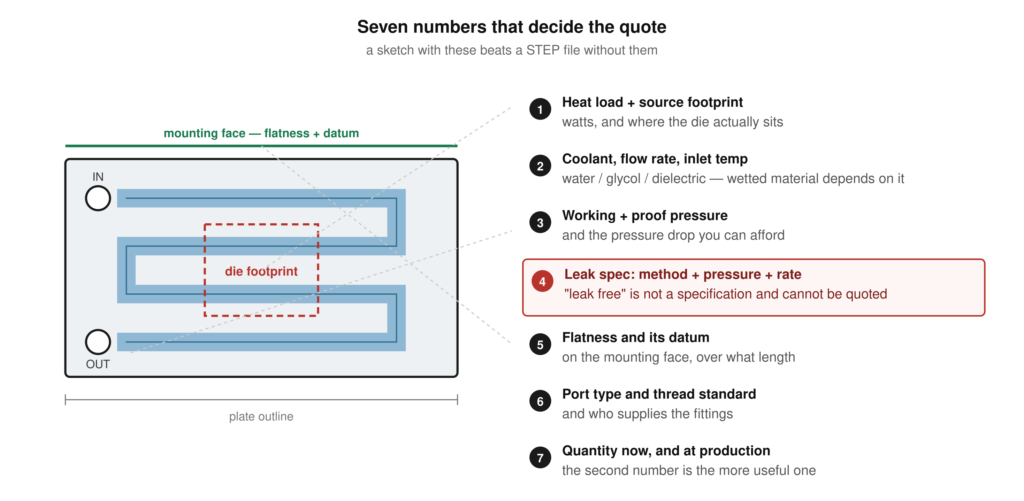
A STEP model and dimensioned PDF drawing are the best starting point. Include the material, prototype quantity, expected production quantity, critical surfaces, joining requirement if already defined, and the inspection or leak-test specification that applies to the part.
For the complete RFQ checklist, pricing factors, and prototype-versus-production cost logic, see our cold plate machining quote guide.
What Comes Back After the RFQ
The first step is a manufacturability review from someone who has opened the files. If the geometry creates a machining, joining, inspection, or cost problem, we raise it before the project reaches a purchase order.
Where a geometry or process change can materially reduce cost without changing the functional requirement, we identify it separately. Where we think the part should be manufactured differently — for example with a bolted prototype construction, or by a local quick-turn supplier because the design is still changing weekly — we will say that as well.
If you are qualifying potential suppliers rather than simply comparing unit prices, our How to Choose a Cold Plate Supplier guide covers the checks we think buyers should make before awarding a project.
Drawings, NDA and Supplier Verification
Drawing confidentiality. Customer drawings are treated as confidential and are used only by the people involved in quoting and manufacturing the project. We will sign your NDA if required.
Manufacturing records. Material, inspection, and other required project documentation should be identified in the RFQ so that the required records are included in the manufacturing scope.
Seeing the equipment. A live video walk of relevant manufacturing equipment can be arranged once a project is under discussion.
CNC Cold Plate Machining FAQ
What materials do you machine for custom cold plates?
Our standard cold plate materials are aluminum 6061 and 6063, and copper C11000 and C10200. Other grades should be reviewed against the specific drawing rather than assumed to be equivalent.
What quantities do you support?
We support single prototypes through repeat batches in the low hundreds. Prototype and production quantities should both be included in the RFQ when future volume is known.
Do you use friction stir welding or vacuum brazing?
For aluminum cold plates we can evaluate friction stir welding or vacuum brazing. For copper cold plates, vacuum brazing is the standard joining route we normally evaluate.
Do you offer copper friction stir welding?
We do not advertise copper friction stir welding as a standard ThermalKerf process. If a drawing specifically requires it, the manufacturing route should be reviewed before quotation.
What leak-test capability do you offer?
Leak testing is quoted according to the test method and acceptance criteria defined by the customer drawing or specification. We do not publish one universal leak-rate value for every cold plate design.
How quickly will you respond to an RFQ?
We respond within one working day. Complex drawings may require technical clarification before a final firm price can be completed.
Can I send a rough design before the drawing is finished?
Yes. A rough model or sketch can be used for an initial manufacturability discussion, but a STEP model and controlled 2D drawing are preferred before the final manufacturing scope and price are released.
Send a Drawing
Send your STEP model and dimensioned PDF drawing to sales@thermalkerf.com, or use the form below.
Every RFQ receives a manufacturability review before pricing. We respond within one working day.