
You ask for ten cold plates and the unit price comes back at something like six times what you expected. Then you ask for a thousand and the unit price drops by more than you expected. Both numbers are usually correct, and the gap between them is not a negotiating position — it is the shape of the cost.
This page is about what actually costs money at low volume, which sealing method is cheapest at which quantity, and the levers that genuinely bring a small-batch price down. Several of those levers involve buying less from us rather than more.
At ten pieces, you are not buying parts
You are buying a setup, and taking ten parts home with it.
Almost everything that makes a cold plate expensive in small quantity happens once, regardless of how many parts follow. Listed roughly in order of how much they hurt:
- The furnace cycle. For a vacuum brazed plate this is the dominant term. A furnace run costs close to the same whether the chamber holds two parts or eighty — the energy, the pump-down, the ramp, the hold, the cool, and the hours of machine time are fixed. Two prototype plates pay for the whole cycle unless they can share the load with other work.
- Fixturing. Friction stir welding needs a rigid fixture that holds the cover against the base under real axial force, and it is specific to your part geometry. Machining needs workholding. Neither cost changes with quantity.
- Programming and first-part setup. Toolpaths, tool selection, proving the program, and the scrap from proving it. On a plate with a complex channel this can exceed the cutting time of the whole batch.
- First article inspection. A dimensional report against your drawing takes the same hours for the first of ten as for the first of ten thousand.
- Leak test setup. Adapters and blanking plates for your specific port arrangement, plus establishing a stable test procedure. The test itself is quick; getting to a repeatable test is not.
- Material minimums. Plate stock and braze filler come in sizes and quantities that do not shrink to fit a ten-piece order. Offcut from a small batch is usually waste.
Divide that stack across ten parts and the per-piece figure looks absurd. Divide it across a thousand and it disappears into the noise. Nothing dishonest happens in between.
One measured example
To put a number on the effect: on a copper plate we costed recently — roughly 200 × 120 mm, serpentine channel — the welding operation alone came out at about two and a half times more per piece at prototype quantity than at production quantity.
Two things about that figure are worth stating clearly. It is one operation out of six or so, not the price of a plate — material, machining, leak test and finishing are all separate. And it is one part from one process; your geometry will move it. The useful content is the ratio, not the number: a factor of roughly two and a half on a single operation, compounding across every operation that carries a setup.
That compounding is why the total gap between prototype and production pricing is usually much larger than any single line item suggests.
Which construction is cheapest depends entirely on quantity
This is the part that changes decisions, so it is worth being precise about it. The three ways of closing a cold plate have completely different cost shapes.
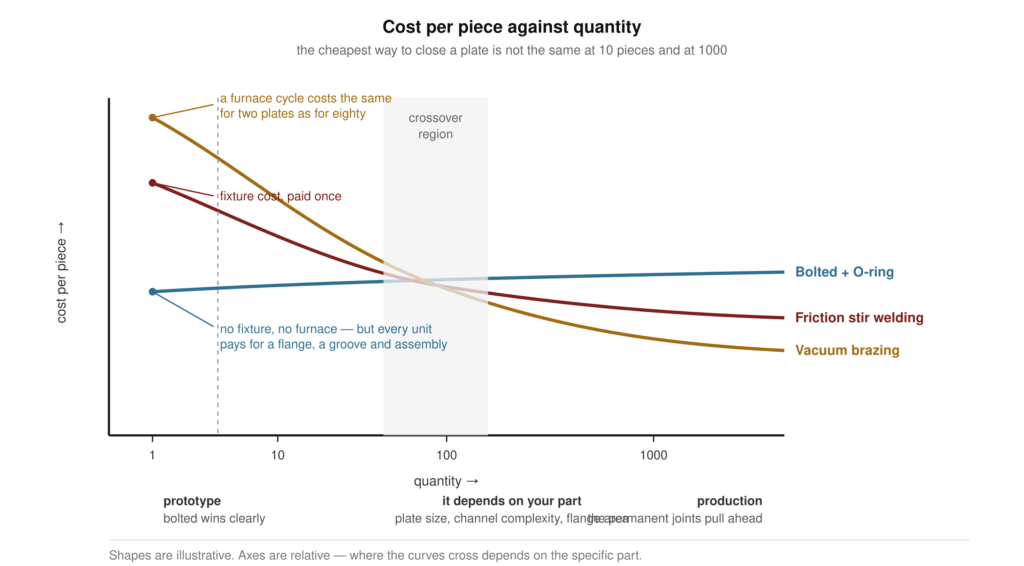
- Bolted cover with an elastomer seal. Near-zero fixed cost — no fixture, no furnace, no welding setup — but a high and flat per-piece cost, because every unit carries machining time for the flange and groove, plus the seal, the bolts, and the assembly labour. Cheapest at the smallest quantities and it stays roughly the same however many you make.
- Friction stir welding. Moderate fixed cost in the fixture, low per-piece cost after that, with machine time proportional to total weld path length. Crosses below the bolted option somewhere in the low hundreds of pieces for a typical plate, and keeps improving.
- Vacuum brazing. The worst small-quantity option and often the best large-quantity one. The furnace cycle is the fixed cost and it is chunky, but once the chamber is full the marginal cost of one more plate is small. It is also the only route to fin inserts, which sometimes removes the choice entirely.
Where exactly the curves cross depends on your plate size, channel complexity, and how much perimeter a flange would eat. But the ordering is stable, and the practical consequence is this: the construction that is right for your production part is frequently the wrong one to prototype in.
Which method suits your part on grounds other than cost is covered in Vacuum Brazing vs. Friction Stir Welding for Cold Plates.
Eight ways to bring a low-volume price down
In rough order of how much they usually save.
- Prototype in a bolted design even if production will be brazed. The single biggest lever, and the one most often refused on principle. Keep the channel geometry identical and change only how the cover attaches. You validate the thermal and hydraulic behaviour, which is what a prototype is for, without paying for a furnace cycle or a fixture. Draw it with the eventual joint in mind — leave the rib widths and corner radii the production process will need — and the transition later is a drawing change rather than a redesign.
- Batch your iterations instead of trickling them. Three separate orders of four plates cost far more than one order of twelve, because you pay the setup three times. If you know three variants are coming, send all three at once and ask for them to be run together — much of the setup is shared even between different geometries in the same family.
- Ask whether your brazed parts can share a furnace load. If your two plates go into a cycle that is running anyway, the cost picture changes completely. This depends on other work in the queue and on compatible cycle parameters, so it cannot be promised — but it can be asked for, and a flexible delivery date makes it far more likely. If you can accept “within the next three weeks” instead of a fixed date, say so; it is worth real money.
- Relax the tolerances that are not doing work. Blanket tolerance callouts applied to a whole drawing are expensive at low volume, because tight tolerances mean more setups, slower passes, and more inspection — all of which are per-part costs that low volume cannot dilute. Tighten the mounting face flatness and the port positions; leave the rest open.
- Design to standard stock thickness. A base that starts from a standard plate thickness avoids a facing operation across the whole surface, and an overall height that lands just above a stock size forces you into the next size up and machines most of it into chips.
- Do not over-specify the leak test. Moving from pressure decay to helium changes equipment, cycle time, and possibly the supplier list. Sometimes it is genuinely necessary. Often it is inherited from another program. Leak testing cold plates covers how to arrive at a number you can defend.
- Ask for pricing at two or three quantities up front. If you are preparing an RFQ, our cold plate machining quote guide lists the drawing, quantity, joining, inspection and test information to include before pricing. Not to negotiate — to see the shape. If the price at 10 and the price at 500 are close, the part is material-dominated and there is little to gain from volume. If they are far apart, the setup costs are large and it is worth asking which ones and whether any can be avoided. Either answer tells you where to push.
- Do not split a small order across suppliers. Splitting ten pieces between two shops means paying two setups for five parts each, plus two first articles, and you will get two subtly different parts. Split at production, not at prototype.
On MOQ
Minimum order quantity for a custom machined part is rarely a policy. It is a threshold below which the price stops being defensible, and it moves with the part.
A bolted plate has effectively no minimum — one is fine, it just costs what one costs. A friction stir welded plate has a soft minimum set by whether the fixture can be justified. A vacuum brazed plate has the hardest floor, because of the furnace cycle, and that floor moves depending on what else is in the queue.
So a published MOQ figure is mostly marketing. The question worth asking a supplier is not “what is your MOQ” but “at what quantity does this specific part stop being dominated by setup” — and a shop that has looked at your drawing can answer that, while a shop quoting from a rate card cannot.
When low volume from overseas is the wrong call
Stated plainly, because it applies to a fair share of the enquiries we receive.
If you are iterating weekly and each round teaches you something, transit time is your dominant cost and no unit price makes up for it. Buy locally until the geometry settles, then move the production part. The premium you pay a domestic shop for a handful of fast iterations is almost always smaller than the schedule you lose waiting on freight for a design you are going to change anyway.
The same applies if the quantity is genuinely one or two and will never be more. The setup cost lands the same way wherever the shop is, and you lose the advantages of being in the room.
Where overseas low-volume work does make sense: a stable design, a quantity in the tens or low hundreds, a schedule with a few weeks of slack in it, and a part where the machining content is high enough that the labour difference is worth something.
Send a drawing
Send the drawing with the quantity you need now and the quantity you expect at production, and you will get both prices — plus a note on which costs are setup and which are per-piece, so you can see where the money is.
If a change to the design or the sealing method would make the small quantity substantially cheaper, we will propose it. If we think you should prototype this locally and come back at production, we will say that instead. Details of what we build are on the cold plate machining page.
Manufacturability check before a price, and a reply within one working day.