
This page is about machining copper cold plates: what changes at the machine, what changes in the joining step, and what changes in the price. It starts with the argument against copper, because a large share of the drawings that reach us specifying C1100 would perform almost identically in aluminum for a fraction of the material cost.
If you already know you need copper and you want a number, the fastest route is to email the drawing. Everything below is for the case where the material decision is still open, or where a copper part has come back warped, leaking, or three times over budget and you want to know why.
Start here: does the plate actually need to be copper?
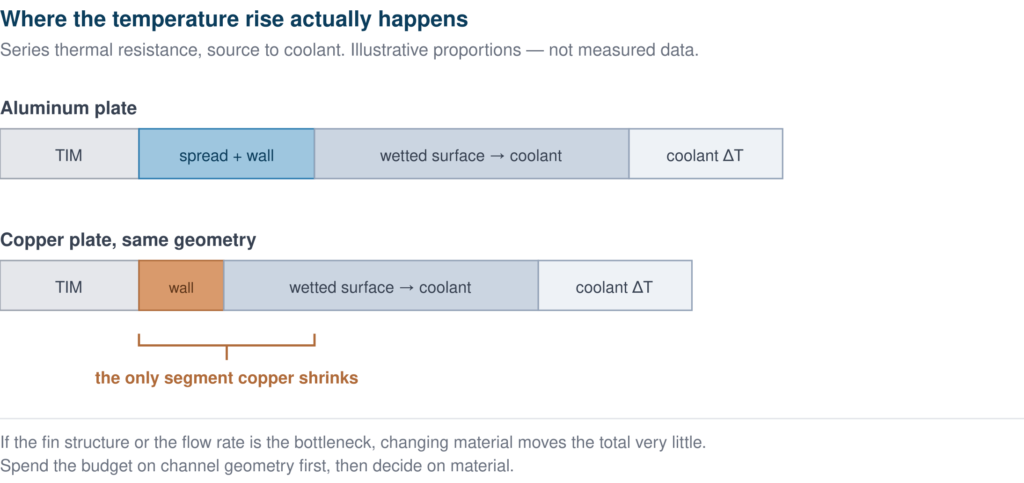
Copper conducts heat at roughly 400 W/m·K. The 6000-series aluminum alloys used for most cold plate bodies land near 170. On a spec sheet that looks like a decisive advantage. In an assembled cold plate it usually is not, because bulk conduction through the plate wall is only one term in a series of thermal resistances, and it is rarely the largest one.
The chain runs: die to package, package to thermal interface material, TIM to plate face, through the plate wall, from the wetted fin or channel surface into the coolant, and finally the bulk temperature rise of the coolant itself as it crosses the plate. Copper only shortens one link.
Two cases where copper genuinely earns its cost:
- High heat flux under a small footprint. A 600 W GPU die concentrated into a few square centimetres creates a spreading problem, not a bulk conduction problem. The heat has to fan out laterally before it reaches the fins, and lateral spreading is exactly where conductivity dominates. This is the direct-to-chip case, and it is a real one.
- Very fine fin or pin structures. Once fin thickness drops below roughly half a millimetre, conduction along the fin height becomes a limiting term. Copper fins stay closer to base temperature than aluminum fins of the same geometry, so more of the wetted area actually does work.
Cases where copper is usually the wrong answer:
- Large multi-component baseplates. Several devices spread across a 300 mm plate, none of them at extreme flux. The dominant resistance is the fluid-side term. Copper adds weight and cost and buys a couple of degrees.
- Anything where mass matters. Copper is about 3.3 times denser than aluminum. A plate that is manageable in aluminum becomes a two-hand part in copper, and the mounting hardware and rack loading have to absorb it.
- Designs still in flux. Copper stock is expensive enough that scrapping an iteration hurts. Prototype in aluminum, confirm the channel layout works, then switch material if the thermal budget still demands it.
The advice that costs us money: if you are not sure, quote both. Send the same drawing with the material line changed and compare. If the copper version is not buying you a temperature margin you can point at in a simulation or a test report, take the aluminum one. We would rather machine the aluminum plate and keep the customer than machine the copper one and have the price kill the programme.
What copper does differently at the machine
Copper is not harder than aluminum. It is softer and more ductile, and that is the problem. The failure modes are different from what an aluminum-heavy shop is used to, which is why a shop that quotes copper at “aluminum price plus material” is usually a shop that has not machined much of it.
Chips and built-up edge
Copper produces long, stringy, continuous chips that want to wrap around the tool and re-enter the cut. A recut chip in a finished flow channel leaves a witness mark; a recut chip on a sealing face leaves a scratch that will follow the O-ring groove all the way to the leak test. Copper also adheres to the cutting edge, forming built-up edge that periodically breaks away and takes surface finish with it. Sharp, polished, high-rake tooling and aggressive chip evacuation matter more here than raw spindle power.
Burrs
Ductile material means burrs roll over rather than break off. On a cold plate this is not cosmetic. Burrs at channel intersections and at the inlet and outlet bores end up as loose particulate in a closed loop, and a burr on the joint face is a leak path. Deburring copper flow channels is manual, slow, and a genuine cost line — not something that disappears at volume the way setup cost does.
Thin fins and thin walls
The usual assumption is that copper fins deflect more than aluminum ones. They do not. Copper’s elastic modulus is roughly 117 GPa against about 69 GPa for 6061, so a copper fin is the stiffer of the two against springback. What copper lacks is yield strength — annealed copper gives way at a fraction of the stress 6061-T6 tolerates. The failure is plastic, not elastic: a thin fin bends and stays bent, smears at the tip, and rolls a burr rather than shedding one. Combined with the adhesion described above, the practical floor on fin thickness in copper is set by permanent deformation and surface finish, not by tool deflection. Expect lighter radial engagement, more passes, and a quote that reflects both.
The same limit shows up on air-cooled parts, where fins are usually taller and the gaps narrower. What that does to the cost of a machined copper heatsink is covered separately.
A 0.4 mm copper fin standing 5 mm tall will push away from the cutter. The result is a fin that measures correctly at the root and thin at the tip, or a fin with a visible lean. Aluminum of the same geometry is stiffer and more forgiving. If your drawing calls out fine machined fins in copper, expect the process to involve lighter radial engagement and more passes — and expect that to show in the quote.
This is also the point where the channel and fin geometry decisions stop being a thermal question and become a manufacturing one. If you want fin pitch below what machining supports economically, skiving is usually the better route in copper — it produces fine fins by peeling them from the solid rather than cutting the gaps away, and copper skives well.
Warping and flatness: the failure that shows up last
Rolled copper plate carries residual stress. Machining a deep channel pattern into one face removes material asymmetrically and releases that stress unevenly, and the plate bows. Then the joining step — whether that is friction stir welding or a furnace cycle — puts heat into the part and releases more. A plate that measured flat on the CMM before joining can be out of tolerance after it.
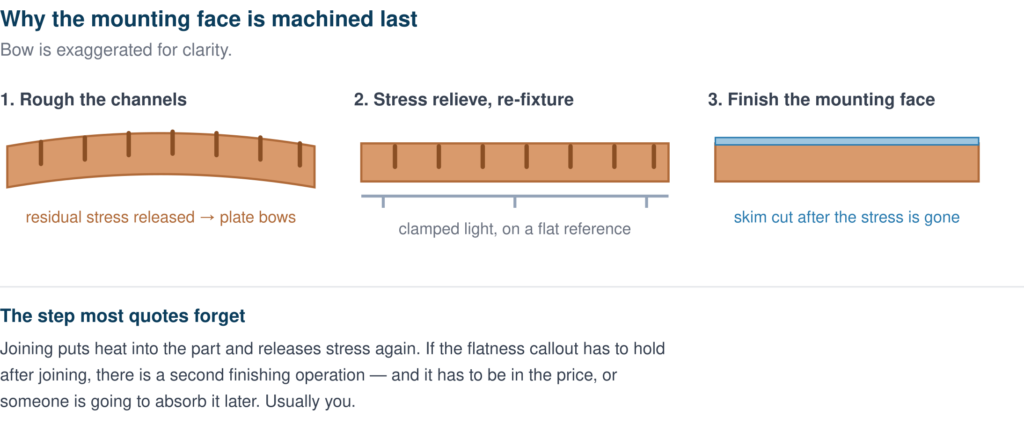
The practical consequence: a flatness tolerance on a copper cold plate is only meaningful if the drawing says when and how it is measured. After machining or after joining. Free-state or clamped. Over the whole face or over the die footprint. Those are four different parts at four different prices.
Here is the version of this that works against us: do not ask us for a flatness number over email, and be suspicious of any supplier who gives you one. A number quoted without a fixture, a measurement method and a stage in the process is a sales number. Send the drawing, and let the answer come back tied to your actual geometry and your actual joining process. It is a slower answer and a less satisfying one, and it is the only kind that survives first article inspection.
Joining copper is not joining aluminum
Most cold plate joining knowledge in circulation is aluminum knowledge. Copper changes the picture in ways that matter to the quote.
- Friction stir welding. Copper’s higher melting point and thermal conductivity mean the tool runs hotter and the process needs higher forces and slower travel than aluminum. Tool material and tool life are a real constraint, not a footnote. FSW on copper is done routinely, but a shop’s aluminum FSW experience does not automatically transfer.
- Vacuum brazing. A different filler system from aluminum brazing, and a different set of material constraints. The one worth knowing as a buyer: standard ETP copper (C11000) contains residual oxygen and can suffer hydrogen embrittlement if it is heated in a hydrogen-bearing furnace atmosphere. Oxygen-free grades (C10100 / C10200, often written OFE or OFHC) avoid the issue. If your drawing says “copper” without a grade and the part is going to be brazed, that is a gap worth closing before anyone quotes it.
- Epoxy or gasketed lids. Cheap, reversible, and limited on pressure and temperature. Fine for a bench prototype, usually not for a rack that has to run for years.
The trade-offs between the two serious options are covered in more depth in the comparison of vacuum brazing and friction stir welding, including where each one tends to fail.
One question to put to every supplier you approach, including us: is the furnace yours, or is the brazing subcontracted? Neither answer disqualifies anyone. A subcontracted furnace with a stable partner and a documented braze schedule is fine. What is not fine is a supplier who will not answer the question, because it means you cannot trace a joint defect back to anyone. The wider set of questions that separate a manufacturer from a broker follows the same logic: you are not testing capability, you are testing whether the answers are specific.
Where copper money actually goes
Buyers usually expect the machining to be the expensive part. On a copper cold plate it often is not.
| Cost line | Aluminum plate | Copper plate |
|---|---|---|
| Raw stock | Modest share of the total | Often the single largest line |
| Machining time | Fast metal removal | Slower on fine features; more finishing passes |
| Deburring / cleaning | Contained | Manual, and does not scale away |
| Post-join flattening | Sometimes needed | Frequently needed |
| Scrap value of chips | Low | Meaningful — ask whether it is credited back |
Two things follow from this that are worth acting on.
First, copper quotes have a shelf life. Copper is an exchange-traded commodity and the price moves. A copper cold plate quote that is silent on how long it holds, and on what happens if the metal price moves before you release the order, is incomplete. Ask. And check the current copper price yourself before you accept a quote — it takes thirty seconds and it tells you whether the number you are looking at is stale.
Second, the prototype-to-production gap is narrower in copper than in aluminum, in ratio terms. Setup and programming amortise across a production run, but material cost per part does not, and in copper that material cost is a larger fraction of the total. The practical effect is that copper parts get less cheap at volume than buyers expect. The mechanics of that ratio, with a real example from a joining operation, are set out in the page on how prototype and production pricing actually diverge.
Surface treatment and plating
Bare copper oxidises. In a closed liquid loop with the right coolant chemistry and inhibitor package that is largely a non-issue; on external surfaces and sealing faces it is a cosmetic and handling issue that shows up as customer complaints about parts arriving discoloured.
Electroless nickel is the usual answer. Two things to specify rather than assume:
- Whether the internal flow path is plated. Plating deposits inside fine channels and reduces hydraulic diameter. On a coarse serpentine that is irrelevant. On a fine microchannel or pin fin array it is not, and the pressure drop your simulation predicted is not the one you will measure.
- Whether the die contact face is plated. A plating layer adds a small thermal resistance in the exact place you are trying to remove it, and masking that face costs money. Decide deliberately; do not let it be decided by whoever writes the routing.
What we will not quote
Being explicit saves both sides a week.
- Complete liquid cooling systems, CDUs, manifold assemblies and quick disconnects. Not our scope. We make plates and machined thermal parts.
- Anything you need in a week. If your schedule cannot absorb international shipping, use a domestic quick-turn shop. That is not modesty, it is arithmetic.
- Designs iterating weekly. While the geometry is still moving, buy locally and pay the premium for the feedback loop. Come back when the design is stable and volume is the question.
- Copper-tungsten, diffusion-bonded microchannel stacks, and other specialist processes. These exist and they solve real problems at the top end of the flux range. They are not what this shop does, and a supplier who says yes to everything is telling you something.
Sending a copper cold plate for quote
What makes a quote fast and accurate:
- STEP or Parasolid, plus a PDF drawing with the tolerances that actually matter marked as such
- The copper grade, or a note that you want a recommendation — particularly if the part will be brazed
- The intended joining process, or a note that it is open
- Flatness callouts with the stage and method they apply to
- The leak test requirement, including the standard and the acceptance level if you have one — how leak specifications get written and misread is a common source of re-quotes
- Prototype quantity and the realistic annual volume, stated separately
What comes back: a manufacturability review before pricing, with anything in the geometry that will cost you money for no thermal benefit flagged in writing. We reply within one working day. If the honest answer is that aluminum does the job, or that this part belongs at a domestic shop, that is what the reply will say.
Drawings go to sales@thermalkerf.com. For anything else, the form below reaches the same inbox. If the material question is settled and you want the process page rather than the material page, see CNC machined cold plates.